Tuesday, April 5, 2011

Murdochs men at the MET like to be seen 'to be busy'..Neville and Ian will be home for 'cocktails' this evening...

Phone hacking: NoW journalists arrested

Former news editor and current chief reporter arrested after presenting themselves at separate London police stations
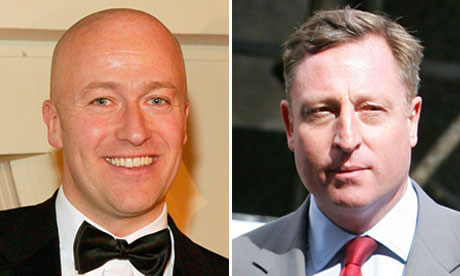
Ian Edmondson, left, and Neville Thurlbeck
Ian Edmondson, left, and Neville Thurlbeck. NoW's former news editor and current chief reporter have been arrested. Photograph: Phil Adams/Rex Features
The former news editor and current chief reporter from the News of the World are in police custody after being arrested on suspicion of unlawfully intercepting mobile phone voicemail messages.

Ian Edmondson and Neville Thurlbeck had voluntarily presented themselves at different London police stations this morning and were arrested. It was expected their homes would be searched by officers at midday.

Scotland Yard has confirmed that two men, aged 50 and 42, "were arrested this morning after attending separate police stations in south-west London by appointment".

"They remain in custody for questioning after being arrested on suspicion of conspiring to intercept communications, contrary to Section 1(1) Criminal Law Act 1977, and unlawful interception of voicemail messages, contrary to Section 1 Ripa [Regulation of Investigatory Powers Act] 2000," the briefing added.

"The Operation Weeting team is conducting the new investigation into phone hacking. It would be inappropriate to discuss any further details regarding this case at this time."
The Guardian understands that Edmondson, NoW's former head of news, is being questioned by officers at Wimbledon police station. Thurlbeck, the paper's chief reporter, is at Kingston police station.

The arrests are the first salvo in Operation Weeting, whose tasks include establishing whether there are grounds for bringing further prosecutions in the phone-hacking scandal.
Edmondson and Thurlbeck will probably be released later this afternoon after the search of their homes is complete.

The two men have been implicated in the long-running scandal through documents seized from Glenn Mulcaire, the private investigator employed by the newspaper.

Edmondson, who was sacked from NoW in January, denies any wrongdoing.

Thurlbeck was interviewed by police last autumn. No charge has been brought against either man, both of whom have denied all involvement in criminal activity.

The arrests come on the day that Keir Starmer QC, director of public prosecutions, gives evidence at a home affairs committee from witnesses into the unauthorised intercepting of communications.

Only one reporter, the former royal editor Clive Goodman, has been convicted of a crime as part of the scandal.

He and Mulcaire were sentenced to jail terms in January 2007.

No other reporters or executives were questioned by the initial police investigation. It was only after a series of high court cases brought by the actor Sienna Miller, the football pundit Andy Gray and others that the Metropolitan police were forced to reveal material found on Mulcaire's computer, during a 2006 raid of his home.

Last Friday, a high court judge ordered NoW to make available Mulcaire's notes to the growing list of people suing the paper. Justice Geoffrey Vos, who is in charge of the hacking cases, ordered "rolling disclosure" to all claimants.

Hundreds of thousands of emails will now be handed over to alleged victims.

News International later said in a statement: "In January, News International voluntarily approached the Met Police and provided information that led to the opening of the current police investigation.

"News International terminated the employment of the assistant editor (news) of the News of the World at the same time.

"News International has consistently reiterated that it will not tolerate wrong-doing and is committed to acting on evidence.

"We continue to co-operate fully with the ongoing police investigation."

http://www.anhourago.co.uk/show.aspx?l=8355139

http://www.anhourago.co.uk/show.aspx?l=8354771

Sunday, April 3, 2011

Another Murdoch joins The Times board - with a retired spy

How independent is independent? With Rupert Murdoch supposedly on the brink of solving his BSkyB dilemma by hiving off Sky News to an independent trust of some sort, we discover that his eldest daughter, Prudence, has joined the board of Times Newspaper Holdings.

According to the London Evening Standard, Prudence MacLeod was appointed by her father.

The appointment was made on 28 January, along with two others: Kai Diekmann, editor of Germany's Bild newspaper, and the former MI6 boss Sir John Scarlett. Maybe that's why the changes were kept secret? Only joking, but it's funny that these kinds of appointments were not announced with a fanfare.

After all, the board has an important public function. It was set up to guarantee the independence of The Times and Sunday Times when Murdoch acquired the titles in 1981 (details here).

There are other News Corp appointees on the current 19-person board, including Rupert himself of course.

The real (well, alleged) guarantors of independence are the six "independent national directors" who exist within the board structure. Call it embedding, if you like.

They are Tory peer Lord Marlesford (formerly Mark Shuldham Schreiber); former Whitehall mandarin Sir Robin Mountfield; former deputy governor of the Bank of England Rupert Pennant-Rea; corporate PR and former Times journalist Sarah Bagnall; and Baroness Eccles, once described in the Daily Telegraph as "a quango-junkie." Her Wikipedia entry bears that out.

There are only five at present because the sixth, John Gross, the onetime Sunday Telegraph critic, died in January and has yet to be replaced.

As for the other directors, two are certainly no surprise: James Murdoch, son and putative heir, and Rebekah Brooks, lady with red hair. There are also two former senior News International executives, Andrew Knight and Jane Reed.

One of Murdoch's oldest aides, the lawyer Richard Searby, is listed despite living in Australia.


Then come the journalists: Peter Stothard, the former Times editor, now editor of the TLS; Sarah Baxter, Sunday Times magazine editor; and Anoushka Healy, Times managing editor.

There is a second Tory peer, Lord (Brian) Griffiths, and finally, there's the company secretary, Carla Stone.

Anyway, what do the independent directors get up to? A tiny glimmer of light was cast in a letter from four of them to The Guardian a couple of weeks ago.

We think your readers would benefit from an understanding of our role and responsibilities, it said.

The role, it continued, "is to ensure that the editors of The Times and Sunday Times are able to run the newspapers according to their own judgments and with resources that are adequate for the task...

"Our remit is to protect the editors and editorial policy from interference from the proprietor. We are always available for the two editors to raise any questions or concerns about their ability to run the newspapers as they see fit."

Their role is "most obvious", they explained. in the appointment or firing of an editor. As light duties go, this must rank as one of featherweight proportions.

The Sunday Times editor, John Witherow, was appointed in 1994 and James Harding was given The Times's chair in 2007.

Have either ever raised "any questions or concerns" about their ability to run their papers with the independent directors? Come on boys, do tell.

http://www.guardian.co.uk/media/greenslade+rebekahwade

MPs ask Rebekah Brooks for details of Sun's payments to police News International chief executive told Commons committee in 2003 that payments had been made to officers


Share   James Robinson guardian.co.uk, Wednesday 30 March 2011 19.52 BST Article history


Rebekah Brooks told a select committee in 2003 that her journalists had paid the police for information.

The News International chief executive, Rebekah Brooks, was asked by the chair of a Commons committee late on Wednesday to provide details of payments made by the Sun newspaper to police officers.

The request to the paper's former editor, who now runs all of Rupert Murdoch's UK newspapers, follows evidence given by John Yates, the acting deputy commissioner of the Metropolitan police, to the home affairs select committee on Tuesday.

Keith Vaz MP, the chairman of the committee, wrote to Brooks on Wednesday asking her for information on how many officers were paid for tips or stories, the amounts they received and when the practice stopped.

Brooks edited the paper for six years from 2003 and was previously editor of its Sunday sister title the News of the World.

Eight years ago, Brooks told the culture, media and sport select committee that "We have paid the police for information in the past." She was appearing with then News of the World editor Andy Coulson, who later resigned after it emerged that one of his journalists had used a private investigator to hack into voicemails left on the mobiles of members of the royal household.

Questioned on Tuesday about Brooks's admission, Yates told MPs that the Met is "doing some research" into her remarks. It is not clear if Scotland Yard has ever questioned Brooks about the payments she referred to.

In his letter of Wednesday, Vaz reminded Brooks: "In March 2003, whilst editor of the Sun newspaper, you gave evidence to the culture, media, and sport committee. You stated that the newspaper had paid police officers for information."

Paying police officers is a criminal offence.

 Yates said during separate evidence he gave to the culture committee last week that "possible offences" might have been committed.

Vaz asked Brooks to reply by Tuesday, when the committee will question the director of public prosecutions, Keir Starmer, as part of its ongoing inquiry into phone tapping.

Yates and Starmer are engaged in a public row about the original 2006 police investigation into phone hacking at the News of the World.

Yates insists Scotland Yard was told by the CPS to adopt a narrow definition of the offence which made it difficult to obtain convictions, a claim he has repeated four times before two parliamentary committees. Starmer denies this.

News International had not returned a request for comment by the time of publication.

• To contact the MediaGuardian news desk email editor@mediaguardian.co.uk or phone 020 3353 3857. For all other inquiries please call the main Guardian switchboard on 020 3353 2000. If you are writing a comment for publication, please mark clearly "for publication".
• To get the latest media news to your desktop or mobile, follow MediaGuardian on Twitter at http://twitter.com/#!/mediaguardian and Facebook at http://www.facebook.com/mediaguardian

http://www.guardian.co.uk/media/2011/mar/30/mps-ask-rebekah-brooks-sun-payments-to-police?CMP=twt_gu

Friday, April 1, 2011

MURDOCH: When one looks back at the 'tapes' and the fallout of Diana and Charles very public divorce..... The scandal now of phone hacking and the MET involvement one must wonder how involved was Murdoch in helping the Prince blacken Dianas name when she was at her most vulnerable.

http://www.independent.co.uk/opinion/telephone-exchange-that-taps-out-divorce-1543379.html

Facing down Dad

In an exclusive interview with Robert Peston, James Murdoch, the new head of BSkyB, promises that he will not be a puppet of his father Rupert, the firm's chairman

What's wrong with this statement? "The relationship between the chief executive and the chairman of the company as it pertains to the strategy of the company, the performance of the company, everything that happens in the company, is in the professional category."
Well, nothing at all, if made by most FTSE100 chief executives: it would be the sort of "worthy-but-dull" declaration that's barely worth recording. But the speaker is James Murdoch, the new chief executive of British Sky Broadcasting, and the chairman in question is his father, Rupert Murdoch, the legendary media mogul.
I'm interviewing the younger Murdoch in his unglamorous corner office, with a view over the congested and ugly A4, in the satellite broadcaster's sprawling west London campus.
And he's producing some agonising linguistic constructions not to use the "dad" word (or "pop", as he supposedly calls him in private) in an attempt to prove that blood ties to his father - whose News Corporation owns 35.4 per cent of BSkyB - will not distort his responsibility to serve all shareholders.
It's a must, because his appointment last week to the helm of the UK's largest media group - with a market value of £12.87bn - led some BSkyB investors to shriek "nepotism" and worse.
So what would he do if "the chairman" tried to push him to adopt a strategy for BSkyB with which he disagreed? Wouldn't his natural love and respect for his father put him under enormous pressure to go against his better judgment?

He fixes me with a stare and says: "The key thing to understand, that is very important for me to get across, is that in taking this role there is absolutely no question in my mind who I work for: it's the board of the company and all of the shareholders of the company.

"And in executing those duties, I and the management team will do everything we can to maximise value for all those shareholders. And to the extent there are disagreements on strategy, we will make it plain. If we disagree about something, we will disagree and we will hash it out."

So how does he manage this tension between the demands of family and the imperative of putting the company first? "I should tell you that my relationship with my father is on the one hand a professional relationship and on the other hand a personal relationship."

I ask what's in the "personal" category. "I'm not going to tell you . . . fishing or something."
Anyway, a BSkyB non-exec tells me that Murdoch Junior said "no" to the chairman in his very first 24 hours in his new post. This was over his decision - which he is carrying out - to resign from all the positions he holds in his father's News Corp empire.

"Rupert didn't want him to do it," says the director, "but James was adamant." When I ask the son about this, he is palpably embarrassed and refuses to be drawn.

He implies, however, that he has tested his father's patience in the past, over his decision in 1995 to quit his course in film and history at Harvard a year before graduation (to set up a record label called Rawkus). "Any father has concerns about that sort of thing," he says.
If there is inner turmoil between the professional and the personal, it's well hidden. He's all charm and impeccable manners - which is impressive for someone who is only 30. In fact, he looks even younger. With his soft Henry Jamesish accent, dapper, preppy suit and little round glasses, he's Harry Potter with an Ivy League education.

There are other subjects he eschews. One is his family life (he's married to a marketing executive, Kathryn Hufschmid, and has a six-month-old daughter).

Equally off limits is the way the board appointed him to the CEO post and whether his lineage gave him an unfair advantage over other internal and external candidates.
"How it went and the way the company approached the process are questions for the nominations committee," he says, passing the buck to BSkyB's harrassed non-executives (Lord St John of Fawsley, the former Tory minister, Allan Leighton, the chairman of Royal Mail, and Gail Rebuck, the publisher).

But what prompted him to throw his hat in the ring? He says he learned that the job might be available when he read press reports at the end of the summer that Tony Ball, the incumbent CEO, might be quitting. "I talked with Tony [Ball] and I said 'okay, is this going to happen? Would you enter this process?' and it sort of started."

As for his qualifications to run one of the UK's 20 biggest quoted companies, he concedes that Star Group, the Asian News Corp offshoot he has been running since 2000, is considerably smaller than BSkyB. And although it's in satellite and cable television, its revenues are weighted towards advertising and fees from other cable businesses, while BSkyB's success has been built on selling subscriptions.

However, Star is a complex business - it operates in 53 countries - and in three years he has turned it around from substantial losses, estimated at $100m a year, to operating profits of about $50m now (this includes dividends from businesses it does not control and is an approximation, since News Corp does not publish the precise number).

What are his plans for BSkyB? He is pleased that the board is moving to reconstruct the balance sheet and is taking legal steps that would allow it to start paying a dividend again after a five-year break - which will warm the cockles of independent shareholders.

His strategy is to expand BSkyB's core business, rather than embarking on adventures overseas. "There is a lot of growth left in the UK and Ireland markets. We're excited about these markets. The focus of the company is totally on that, and at this point there are no plans for anything else," he says.

But he refuses to discuss "the longer term issue of volume versus high Arpu [average revenue per user]" - which may sound like gobbledegook but is in fact the central dilemma facing BSkyB.

What it means is that he has not yet decided whether to adopt Tony Ball's approach of increasing the number of subscribers paying the relatively high annual fee of around £400 a year from 7m to 8m by 2005 - or whether to make a push into selling cheaper services to a potentially bigger market.

This uncertainty may unsettle shareholders, since some of them have put to me a conspiracy theory that runs like this.

Murdoch Junior would depress profits and the share price by going for low-margin growth and he would then issue shares to acquire a News Corp television business such as Star or its Italian interests. Hey presto: News and Rupert Murdoch would see their stake in BSkyB increase to above 50 per cent and would have control.

Nothing could be further from his mind, he says. "There are lots of conspiracy theories out there. We're focussed on growing value for shareholders, we are focussed on keeping operational momentum . . . and there aren't any plans for all that other stuff."

That's reassuring. So what will he earn? "I haven't been told," he says (which is the first time I've ever come across a CEO who took a job without driving a hard bargain on pay). "I hope the remuneration committee will be giving me a call soon."

When I erroneously suggest to him that he earned $3m last year, his disarming response is: "Holy cow, I wish it was". But even more strikingly, he doesn't appear to know what he took home, since the numbers he gave me (a base salary of $700,000 and a bonus of $500,000 or "something like that") are wrong. News Corp's annual report says his remuneration in salary and bonus was $2.1m.

Finally, there is the question he probably hates more than any other, which is whether the supposed competition with his older brother Lachlan weighs on him.

In this context, I mention the alleged remark by his mother Elizabeth that the sibling contest to succeed Rupert Murdoch at the helm is a recipe for a "lot of heartbreak and hardship".
He insists he never agonises about the future inheritance. "Look, I've a job, I do the job . . . To play into all that other sort of junk is not worthwhile. Everyone loves doing it, but it's not something that concerns me."


http://www.telegraph.co.uk/finance/2868442/Facing-down-Dad.html

The Hufschmid / Murdoch Coincidence

http://www.erichufschmid.net/HufschmidMurdochCoincidence.html

The SUN revealed details of the sguidgytape

http://www.youtube.com/watch?v=tpjVM06QTtQ